Most of us probably have a story like this—either as the person giving the performance rating or the person receiving it.
One of mine came early in my supervisory career.
I was sitting down with an employee to deliver his year-end performance appraisal. He was surprised that I hadn't rated him as exceptional, so I asked him why he thought he deserved that rating.
“Well...I have shown up for work each day I was scheduled.”
He wasn't joking. He genuinely believed that consistently showing up for his scheduled shifts was evidence of exceptional performance.
I explained that showing up for work was certainly important—but it was a baseline expectation of being fully successful. Exceptional performance required something more.
Looking back, though, the bigger lesson wasn't about him. It was about me.
If we had reached the end of the year with that much difference between his understanding of exceptional performance and mine, I should have had that conversation much earlier. I should have made my baseline expectations clearer. We should have talked about what exceptional performance actually looked like. And I should have been documenting those conversations and his performance throughout the year.

The rating surprised him. It shouldn't have.
Don't Wait for the Form
That lesson may be particularly relevant for federal supervisors right now.
OPM recently established a 40% agency-wide cap on the combined number of Level 4 and Level 5 performance ratings for most General Schedule employees. Supporters argue that limits like this can reduce rating inflation and make exceptional performance more meaningful; critics worry that caps can force distinctions between good employees and make ratings feel comparative rather than individual.
Wherever you land on that debate, the leadership challenge is much closer to home:
Does your employee know today how you think they are performing?
Performance management isn't an annual event. It is a series of conversations.
What are you doing well? Where are you falling short? Here's what I need from you. Here's what exceptional performance looks like. What do you need from me?
In my own professional experience, I have seen the benefits of having those conversations early. They weren't always comfortable, and we didn't always agree. But early conversations gave both of us something valuable: TIME.
Time for me to clarify my expectations. Time for the employee to explain something I may not have understood. Time to coach. Time to adjust. And, most importantly, time for the employee to improve.
That's what feedback is supposed to do.
If you wait until the final appraisal to tell someone they aren't meeting your expectations, you may have accurately documented their performance. But did you really lead them?
Write It Down
There is another side to this that leaders sometimes avoid: documentation.
Don't wait until there is a performance problem to start reconstructing the year.
Keep track of meaningful accomplishments. Capture the feedback you provide. Note missed expectations and the conversations that followed. Document improvement too.
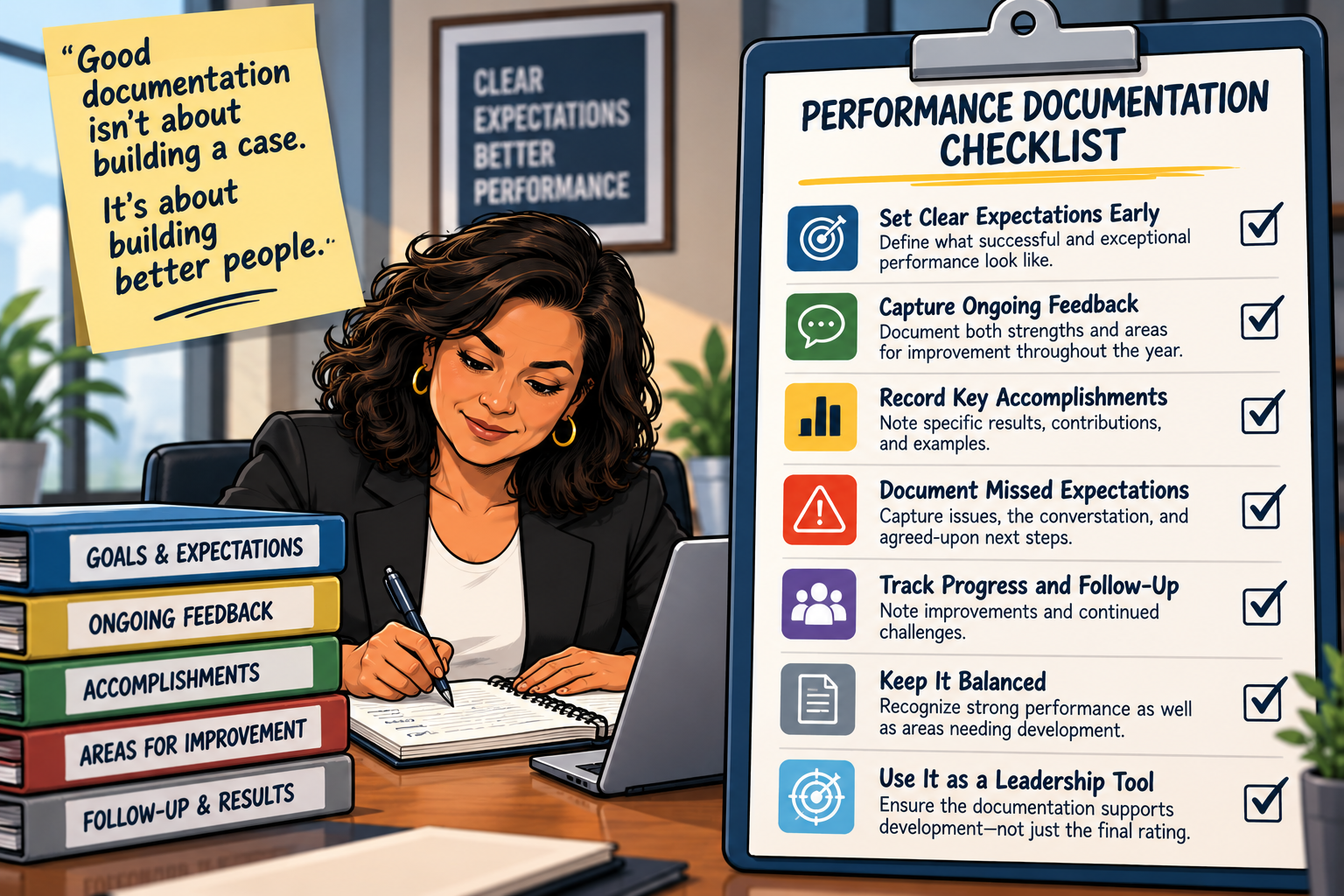
This doesn't have to become an administrative burden. The goal isn't to build a case against someone. The goal is to create an accurate picture of performance over time—for you and the employee.
Good documentation also forces us to examine our own leadership. If I can't explain why I believe someone is exceeding expectations—or falling short—using specific examples, perhaps I need to look more closely before making that judgment.
Ask Yourself Before You Rate Them
Would this employee be surprised by my assessment of their performance?
Have I clearly explained what better performance would look like?
Can I point to specific examples that support my assessment?
Have I given them enough time and support to do something about my feedback?
Have I been as deliberate about recognizing strong performance as I have been about correcting problems?
If some of those questions make you uncomfortable, that's useful information.
Leadership doesn't require us to have every difficult conversation perfectly. Sometimes we need help thinking through how to approach an employee, how direct to be, what to document, or how to balance accountability with development. A trusted peer, mentor, coach, or HR professional can help you prepare rather than avoid.
What matters is that we don't allow discomfort to become silence.
Because silence rarely makes a difficult performance conversation easier. It usually just makes it later.
The humane alternative to an uncomfortable conversation isn't silence. It's an earlier conversation.
J-ZAD Coaching | Leadership Insights | Steady. Purposeful. Present.
